What occurs.
What you do, what USCIS does, and what arrives in your mailbox or your online account.
2026 Rules Edition · Revised October 2026 · Facts checked October 7, 2026
Most delays and denials that you can prevent start in those first four: eligibility, evidence, the form, and filing. This plain-English roadmap walks all eleven stages under the rules that apply in 2026. It was written by a former USCIS officer who spent more than 20 years inside the process.
By Andrew Hedrick · Former USCIS officer, 20+ years
Instant download · 30-day money-back guarantee
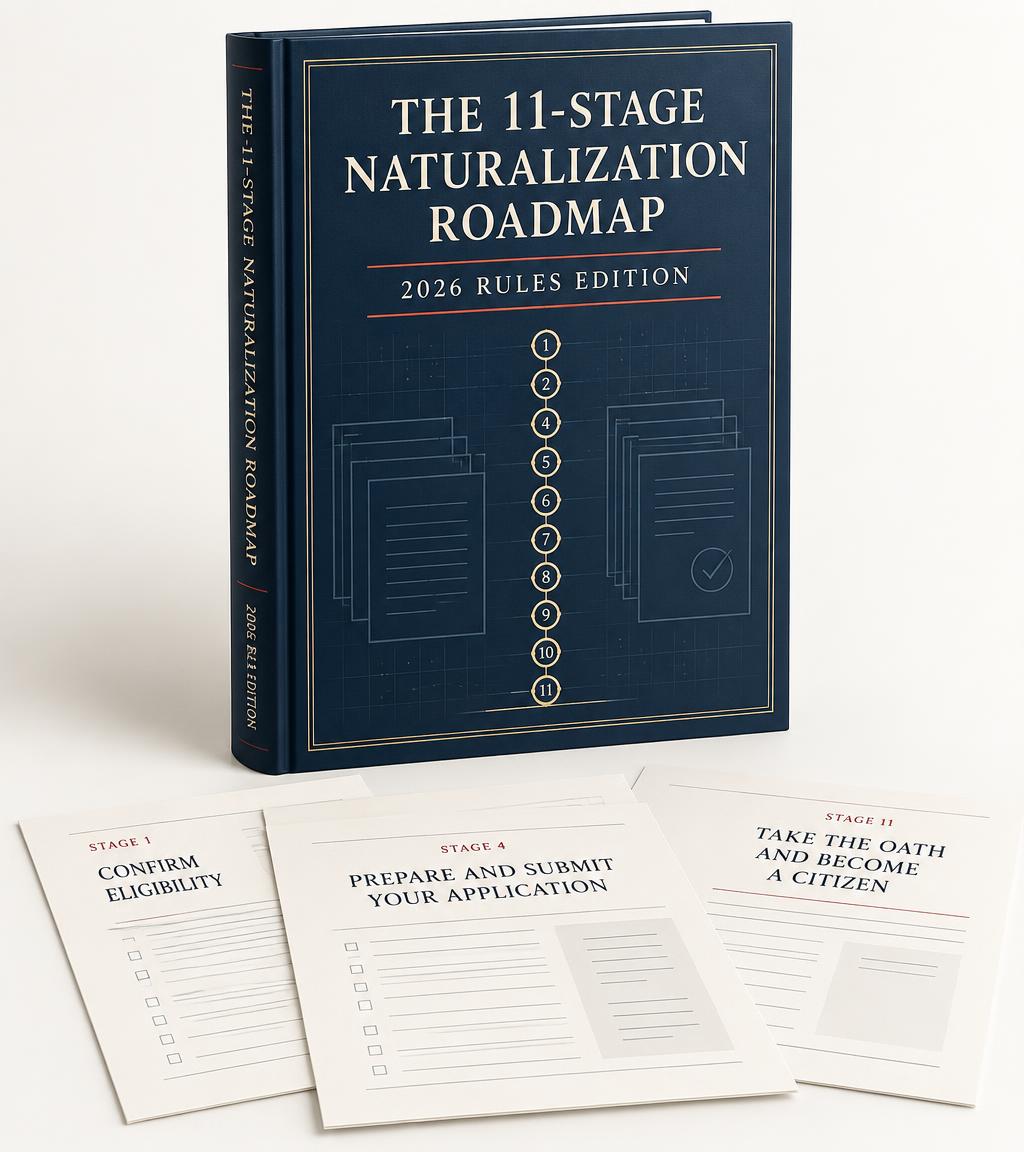
Written for lawful permanent residents preparing to file Form N-400, and for the family members helping them.
Why this edition exists
If a friend naturalized a few years ago, some of their advice no longer applies. These are the changes in date order. The last one starts on October 23, 2026.
| Date | Change | What it means for you |
|---|---|---|
| Aug. 15, 2025 | Character standard | Officers look at your full history and your positive contributions. Having no problems is not enough. You must show good moral character. Source: USCIS Policy Memorandum |
| Oct. 20, 2025 | New civics test | If you filed on or after this date, you take the 2025 test: 20 questions from a list of 128. You must answer 12 correctly. Source: USCIS, 2025 Civics Test |
| Oct. 28, 2025 | Electronic payment | Paper filings are paid by card or U.S. bank account. USCIS no longer accepts a check or money order, unless you qualify for an exemption on Form G-1651. Source: USCIS Policy Alert |
| Apr. 27, 2026 | New FBI fingerprint check | USCIS began receiving more criminal-history data from the FBI. Law firms report that some pending cases were stopped for a new check. Source: Gunster law firm summary |
| June 5, 2026 | Country hold removed | A federal court removed the USCIS hold on cases from travel-ban countries. USCIS said it obeys the order while the case continues. Source: AILA |
| Aug. 5, 2026 | Evidence rule | An officer can deny a case without a Request for Evidence if a required document is missing. Send every document when you file. Source: AILA summary of PA-2026-05 |
| Aug. 25, 2026 | Investigations | USCIS ended its general waiver of personal (“neighborhood”) investigations. It now decides case by case, including for applications already pending. Source: USCIS Policy Alert PA-2026-10 |
| Aug. 31, 2026 | Voter registration | Nonprofit, nonpartisan groups can again register new citizens to vote at administrative ceremonies. Source: USCIS Policy Alert PA-2026-11 |
| Sept. 14, 2026 | Denaturalization review | USCIS checks whether a citizen who files a form, or is connected to one, got citizenship lawfully. Your N-400 answers stay important after the oath. Source: AILA summary of PA-2026-13 |
| Oct. 23, 2026 | Weekend deadlines | From this date, if a deadline counted in days ends on a weekend or federal holiday, USCIS accepts paper it receives on the next business day. Source: AILA summary of PA-2026-15 |
Two proposals: Proposed, not in effect
The fee would go from $710 to $1,280 online and from $760 to $1,330 on paper. The $380 reduced fee and the fee waiver would stop. Military applicants stay exempt. Proposed June 23, 2026; public comments closed August 24, 2026. As of October 7, 2026 there is no final rule.
Source: Federal Register, June 23, 2026An August 2026 rule lets USCIS require online filing for a form after 60 days of notice. USCIS has not named Form N-400.
Source: USCIS alert, August 10, 2026Rules change. This edition is dated, every rule has a link, and the guide tells you exactly what to check again before you file.
Instant download · 30-day money-back guarantee
If you are counting five years and are not certain which day the count started…
If you have taken more than one long trip abroad since becoming a permanent resident…
If you are studying civics without checking which test applies…
This section is about you.
The problem
USCIS publishes almost everything you need. The problem is that it is spread across the Policy Manual, form instructions, Federal Register notices, policy memoranda, a fee schedule, and a study guide, each written for a different reader, none written for you.
So most people assemble their understanding from fragments: a forum post from 2023, a video that predates the current test, or a cousin who naturalized under different guidance.
That is how avoidable preparation problems happen: a trip abroad that quietly breaks continuous residence, an incomplete answer, study for the wrong test, or a surprised neighbor.
“The burden of proof is on you. The applicant must establish eligibility by a preponderance of the evidence.”
The solution
The 11-Stage Naturalization Roadmap walks the naturalization process from the eligibility check to the oath ceremony, and then through your first thirty days as a citizen.
It is not a summary of the USCIS website, and it is not a study guide. It is the sequence: what comes first, what each stage requires of you, and which stages you control. It comes with a workbook and a printable pack so each fact you need is written down once and used again at every later stage.
Instant download · 30-day money-back guarantee
The method
The roadmap is organized by when each stage happens to you, and every stage briefing answers the same four questions in the same order.
What you do, what USCIS does, and what arrives in your mailbox or your online account.
The planning time for the stage, and whether you or USCIS controls the speed.
The fees that apply at this stage, how to pay them, and what USCIS will not refund.
The common problems at this stage, and what prevents them.
Eleven stages, four questions each, one tracker set. Read the one-page overview first, then open each stage briefing when you reach it. A table in the guide shows when to open each tracker. You record a fact once (a date, a document, an answer), and every later stage uses the same record. Each rule has a link to its source, so you can read the original and confirm it still says the same thing.
Instant download · 30-day money-back guarantee
Inside the guide
Eleven short stage briefings, in the order they happen. The first four are the stages you control.
You control this
The general path and the path for spouses of U.S. citizens, side by side. The 90-day early filing rule, and why filing 91 days early can get your application rejected. Why an early filing date does not shorten your reporting window.
You control this
The documents every applicant sends, and the documents your history needs: earlier marriages, long trips, support orders, any arrest. Why, since August 5, 2026, you should not expect a second chance to send a missing document.
You control this
Address history, employment and school history, time outside the United States, and the character questions. How to put all three histories on one timeline so they agree before an officer reads them together.
You control this
Online or paper, full fee or reduced fee, and why the two decisions affect each other. How to pay now that checks are no longer accepted, unless you qualify for an exemption. How your receipt notice extends your green card by 24 months.
What happens at the fingerprint appointment, the FBI record and name checks, why fingerprint results expire after 15 months, and the April 2026 fingerprint change.
What the published processing time actually measures, when your case counts as outside normal processing times, how to reply to a Request for Evidence, and the 10-day address-change rule.
The August 2025 holistic standard and its named positive factors, the August 2026 investigation policy, a character file in five categories, and four specific reference letters: neighbor, employer, colleague, community.
Why the interview is an examination under oath, the topics the officer must cover, why your old forms matter, and what to bring.
How your filing date, not your interview date, sets your civics test. The 2008 and 2025 tests side by side, the English test, the age-based exemptions, the medical disability exception, and your second try.
What Form N-652 tells you, why a continued case is not a denial, the 120-day decision deadline, and the 30-day window to ask for a hearing on Form N-336.
Form N-445 and the questions on the back, the ceremony day step by step, and what to do if you cannot attend.
Passport, Social Security, voter registration, employer and other records, and why your N-400 answers stay important after the oath.
The full process on one page · Plain-language glossary · Seven-problem risk table · Timeline and calendar reminders · 22 pre-filing checks · “Keep this guide current” page · 36 linked sources · Excel workbook with 17 trackers · 17 matching printable worksheets
Instant download · 30-day money-back guarantee
After working through the kit
Name the first day you are allowed to file, and the start of the reporting window that every answer on the form refers to.
Collect every document before you start the form, so nothing required is missing on the day you file.
Make your addresses, jobs, and trips agree on one timeline before an officer reads them side by side.
Build a character file in five categories, and ask for four specific reference letters instead of twelve general ones.
Pay the right fee the right way: online or paper, full or reduced, card or bank account.
Know which civics test is yours before you spend an hour studying the wrong list.
Read your case status honestly, and know when your case is outside normal processing times.
Track the deadlines that protect you: the 120-day decision deadline and the 30-day hearing window.
Recognize the point where your situation needs an attorney instead of a guide, which is the most valuable thing on this list.
None of that changes what USCIS decides. It changes whether you are surprised.
Instant download · 30-day money-back guarantee
Getting ready for your interview
You know which test you are taking, because you checked your filing date against the rule rather than guessing. Your addresses, jobs, and trips already agree on one timeline, so the question about that six-week trip in 2023 has a plain answer. Your folder has tabs in the order the officer will want. Your neighbor, your employer, a colleague, and someone from your community each wrote a specific, signed letter months ago. And the 120-day date is already on your calendar.
The two questions you could not resolve are written on the first page of that folder, because you recognized them as attorney questions and made an appointment.
That is the whole ambition: not a better outcome, but an interview where nothing that happens is new information.
Instant download · 30-day money-back guarantee
A fair comparison
| Option | Cost | Good at | Falls short |
|---|---|---|---|
| Read official sources yourself | Free | Authoritative, current, complete. | Organized by document, not sequence. Assembly can take 20–30 hours. |
| Free videos and forums | Free | Reassuring, specific, human. | Often undated and uncited; older civics guidance may now be wrong. |
| This guide | $27 | The sequence, in order, with a link for each rule, plus 17 trackers, including the 22 checks before you file. | General information; it cannot assess a complicated case. |
| Attorney or DOJ-accredited representative | Varies | Can assess, advise, and represent you. | Costs more and may exceed what straightforward cases need. |
If you have 20 to 30 hours and prefer to assemble this yourself from primary sources, do that. The official guidance is free and complete. You are paying for the ordering and checklists, not private information. If your case involves a criminal record, removal order, prior denial, or unresolved taxes, skip this and choose professional advice.
Instant download · 30-day money-back guarantee
About the author
I’m Andrew Hedrick. I spent more than 20 years as a USCIS officer.
The people who struggled were rarely ineligible. They were unprepared: unsure what a question asked, missing records, studying the wrong material, or unaware a stage existed.
Almost none of that was their fault. The information is public, but it is not organized for the person who has to live it. I wrote this roadmap to organize it, using only public guidance and citations you can check.
Required disclosure: I am no longer employed by USCIS. This guide is an independent educational publication. It is not legal advice and not a legal service. It has no connection to, and is not endorsed by, U.S. Citizenship and Immigration Services, U.S. Customs and Border Protection, the Department of Homeland Security, or any other government agency. It contains no secret or non-public information, and no one can influence the outcome of your case.
Instant download · 30-day money-back guarantee
Clear limits
It helps you organize and prepare. Talk to a licensed immigration attorney or a DOJ-accredited representative for case-specific advice.
It shows you the requirements and helps you check your own numbers. The decision is USCIS’s.
No one outside USCIS can tell you whether you will be approved.
USCIS controls the speed of most stages. The guide shows you which ones.
The guide points you to official guidance by design.
The guide suggests bringing it and your trackers to that meeting, so the meeting is shorter and costs less.
Is this guide right for you?
Instant download · 30-day money-back guarantee
The 11-Stage Naturalization Roadmap
One-time · Instant download · Three-file kit
Instant download · 30-day money-back guarantee
30-day money-back guarantee
Read the whole guide. If it does not give you a clearer picture of the process, email within 30 days for a refund. No form, no explanation, and you keep the checklists.
Frequently asked
No. It is educational information about a public government process, and it is not a legal service. It does not decide if you are eligible, and it cannot account for the specifics of your history. The guide lists six conditions in which you should talk to a licensed immigration attorney or a DOJ-accredited representative before you file.
No. I am a former USCIS officer and I no longer work for the agency. This guide has no connection to USCIS, U.S. Customs and Border Protection, DHS, or any other government agency. It uses only published guidance, with a link for each rule.
Your filing date decides it, not your interview date. If you filed Form N-400 on or after October 20, 2025, you take the 2025 test: 20 questions from a list of 128, and you must answer 12 correctly. If you filed before that date, you take the 2008 test: up to 10 questions from a list of 100, and you must answer 6 correctly. Stage 9 shows both side by side, with the age-based exemptions.
Yes, since August 5, 2026, an officer can deny a case without a Request for Evidence if a required document is missing. That is why stage 2 has you collect every document before you start the form, and why the guide has twenty-two checks to do before you file.
Stages 5 through 11 cover biometrics, the wait, the character review and investigation, the interview, the tests, the decision, and the oath, plus your first thirty days. The earlier stages still help, because the officer compares your answers with your form and with the earlier forms in your file.
A proposal exists; it is not in effect. On June 23, 2026, DHS proposed raising the N-400 fee to $1,280 online and $1,330 on paper and ending the $380 reduced fee and the fee waiver. Military applicants stay exempt. Public comments closed on August 24, 2026, and as of October 7, 2026 there is no final rule. If it becomes final, the rule will give the date. Stage 4 and the guide’s changes pages explain how to think about it.
It is a personal investigation. At a minimum, USCIS checks government records, police records, and the places where you lived, worked, or did business, for at least the five years before you filed. Since Policy Alert PA-2026-10 of August 25, 2026, USCIS decides case by case, including for applications that were already pending. It is not automatic. Good character reference letters can help USCIS decide not to investigate, but they do not guarantee it. Stage 7 covers this, and the workbook has prompts for four letters.
Three files: the 26-page guide (PDF), the workbook with 17 trackers (Excel), and a printable pack of the same 17 worksheets (18-page PDF) for people who prefer paper. A table in the guide shows when to open each tracker.
The guide is dated (revised October 2026, with facts checked on October 7, 2026), and each rule has a link. It also has a “keep this guide current” page that lists what to check again before you file, and where: your test version, the fee and the reduced fee, how to pay, online or paper filing, the processing time for your office, and character and investigation policy. It takes about 15 minutes.
No, and I want to be straightforward about why: doing that would be practicing immigration law, which I am not licensed to do. If you have a case-specific question, that is a sign you should talk to an attorney or an accredited representative.
Email within 30 days of purchase for a full refund. You do not need to explain why, and you may keep the checklists.
Instant download · 30-day money-back guarantee
Three fair objections
Because free and organized are different. Nothing here is private. You are paying for sequence, checklists, and the standard at the point you need it. If you would rather assemble it yourself, go to the official sources and keep your $27.
Yes. Be suspicious of anyone who hints at influence. Andrew cannot see your file, contact the agency for you, influence a case, or promise a result. Every claim is cited so its value does not depend on trust.
Parts of it may. That is why the edition is dated, each rule has a link to its source, and the guide includes a page that lists exactly what to re-check before you file, and where. In about 15 minutes you can confirm the parts most likely to move. A guide that hid its sources or its date would be the one to worry about.
Instant download · 30-day money-back guarantee
When to start preparing
It would raise the online fee from $710 to $1,280 and paper filing from $760 to $1,330. It is not in effect and may change or never be finalized.
Eligible applicants may file up to 90 days early. It is a window, not an open invitation, and miscounting is an avoidable error.
Since August 5, 2026, an officer can deny a case without first asking for a missing document. Ten rules changed between August 2025 and October 2026. Preparation done now is preparation done under the current rules.
What I am not going to do is put a countdown clock on a PDF. There is no expiring discount and no limited number of copies. The price is $27 today and $27 next month. It is the rules that may not wait.
Instant download · 30-day money-back guarantee
Eleven stages, in order, with the four you control marked, seventeen trackers, and a link for every rule. Read it before you file, or read it to understand where you already are.
$27 · Instant download · 30-day money-back guarantee · Not legal advice
Secure checkout
2026 Rules Edition · Revised October 2026
$27 one time
Tax calculated at checkout
Instant download · 30-day money-back guarantee
Loading secure checkout…
Sold by DGSAC Holdings LLC. One-time digital download; 30-day full refund, no explanation required.